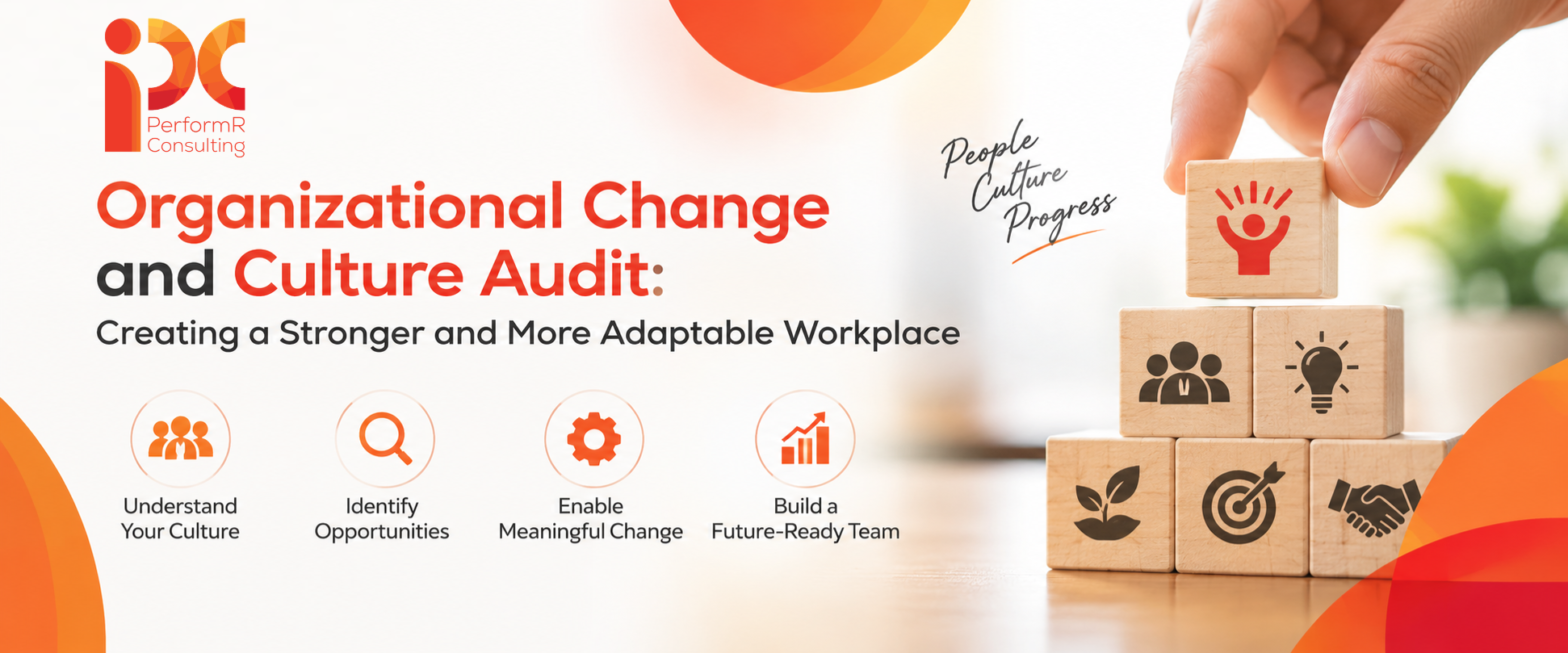
If you go into ten different companies and pose the same question to ten different leadership teams, ‘What’s your culture like?’ you’ll get ten different answers. But ask the employees the same question and you often get a very different picture. It is that gap between what leaders think their culture is and what people experience day to day that kills most transformation efforts quietly.
At PerformR Consulting, we’ve spent enough time in board rooms and break rooms to know that change doesn’t fail because the strategy was wrong on paper. It fails because no one checked if the culture underneath could actually carry the weight. And that’s why, with every transformation engagement, we bring together a structured perspective on the people, habits, and unwritten rules that shape daily life at work, with two things central to how we work: Organizational Change Management Consulting and Culture Audit Services.
This article explains what they both mean, why they are best used together, and how to know if your organization needs them right now.
Why Change Efforts Struggle Without a Culture Check-In
Most companies have a lot of ambition. They have transformation roadmaps, new systems, restructured teams, and leadership decks full of good intentions. But they don’t always take an honest look at whether the culture as it now exists will support or quietly undermine that plan.
Picture yourself as an employee. A new venture has been launched. Leadership says it’s a top-down as well as it cascades peer-to-priority. But the incentive structure remains the same, the same managers who resisted the last three changes are still in charge, and no one has asked the frontline team what is really getting in their way. Six months in, the initiative is “under way” everywhere but where it counts in actual behavior.
This is precisely the problem that organizational change management consulting is designed to address. It’s not just about writing a communication plan and hoping for the best. It’s about diagnosing resistance before it happens, creating real buy-in instead of forced compliance, and ensuring that new ways of working stick once the consultants have left the room.
And that is why Culture Audit Services matter so much before, during, and after any major shift. “If you can’t measure it, you can’t manage it.” A culture audit gives you the baseline, the honest, sometimes uncomfortable picture of how things really work, so change management is not guesswork.
What Organizational Change Management Consulting Actually Involves
When most people think about change management, they imagine a slide deck and a few town hall meetings. In fact, good organizational change management consulting is much more disciplined than that. At PerformR Consulting, we see it as a structured discipline built around people, not just processes.
- Assessing readiness for launch. Prior to rollout, we test for organizational readiness, not leadership’s perception of it. This includes stakeholder mapping, sentiment analysis, and identifying the informal influencers (they’re rarely the people with the fanciest titles).
- Developing a change strategy linked to real behavior. A successful change plan does not only describe the destination. It maps out the specific behaviors that need to change by department and by role and designs interventions around those behaviors rather than generic messaging.
- Creating networks of change champions. Change doesn’t cascade top down as well as it cascades peer to peer. Identifying and providing the right champions across the organization dramatically increases speed of adoption and reduces resistance.
- Two-way communication, not one-way communication. One of the biggest mistakes organizations make is to think of communication as a one-way announcement. Sustainable change requires feedback loops where employees can raise concerns and see them acted on—not just acknowledged in a survey nobody reads.
- Adoption versus completion measurement. The live system is not the end zone. Real change management measures the actual use of the new process, tool, or behavior weeks and months later and modifies support where adoption is not taking off – often tracked alongside our Performance Management frameworks.
That is what differentiates organizational change management consulting from project management. Project management asks, “Did we deliver on schedule?” Change management asks, “Did the organization actually change, and will it remain that way?”
What a Culture Audit Actually Uncovers
Essentially, a culture audit is a systematic inquiry into the difference between your espoused culture and your enacted culture. Every organization has a version of itself it wants to believe in: collaborative, innovative, transparent, and people-first. The audit’s job is to determine whether that story is true.
Our Culture Audit Services at PerformR Consulting normally include multiple levels of insight; one data source rarely provides a balanced perspective:
Anonymous culture surveys that provide a safe avenue for employees to provide honest feedback without fear of exposure.
Focus groups and structured interviews across levels and departments so leadership hears directly from people who are rarely asked.
Manager behavior review – Company values are meaningless if managers behave differently on the ground.
Examining policy and documents, checking how what is said in the handbook stacks up against what actually happens, which is often where gaps in HR Policy & Process Design or HR Manual Development first surface.
Internal communication patterns – is collaboration genuine, or do teams work in silos held together by email chains?
Not some nebulous “culture score.” It’s a data-driven map of exactly where the culture is strong, where it is weak, and where leadership perception differs from employee experience. That map is the foundation for everything that follows – whether it’s a targeted culture-strengthening plan or the foundation for a larger transformation.
Why These Two Services Work Best Together
Here’s the part many organizations miss: change management and culture auditing aren’t separate projects that happen to share a vendor. They’re two sides of the same discipline.
A culture audit without change management follow-through is an expensive diagnosis that has no treatment plan. You end up with a report that has honest, sometimes painful findings but no structured way of acting upon them. Employees who speak up in the survey begin to wonder if anything will ever change, and the next time you ask for honest feedback, you’ll get less of it.
But organizational change management consulting without a culture audit is like prescribing a treatment before running any tests. You may get lucky. More often you are dealing with symptoms—low morale, resistance to a new system, high turnover on a particular team—without knowing the root cause of those symptoms.
When PerformR Consulting brings these together, the sequence usually looks like this:
First, audit. Gain a true understanding of the true culture, the true pain points, and the true hunger for change.
The audit’s findings should inform your change strategy, rather than relying on a generic playbook from another industry.
Establish champion networks, tailored communications, and manager enablement and implement structured change management practices.
Again, measure. A few months later, a second, milder culture assessment will show if the change is real or cosmetic.
This loop is what makes change durable rather than decorative.
Signs Your Organization Needs a Culture Audit and Change Management Support
Not every company requires a full-scale engagement immediately, but some signals tend to appear consistently before things get worse:
Leadership continues to announce “top priority” initiatives that die a quiet death in a quarter.
Exit interviews more often bring up culture, management, or “the way things really work here” than compensation.
Response rates to surveys are falling, or scores are suspiciously and uniformly positive (often a sign that people don’t trust anonymity).
Different departments use noticeably different language to describe the same company.
There is a merger, restructuring, leadership transition, or period of rapid growth happening, and nobody has asked if the current culture can handle it – a scenario where a fractional CHRO can also help steer the broader people strategy.
Company values are not consistently reinforced (and may be undermined) by management.
If two or more of these sound familiar, that’s usually a strong signal that it’s time to bring in structured, outside support rather than trying to self-diagnose from inside the system.
How PerformR Consulting Approaches This Work
We don’t believe in generic frameworks, and we are honest that culture work takes more time to show results than a typical software rollout. What we offer is a disciplined, evidence-first process. We collect data honestly. We report clearly, without sugar-coating uncomfortable truths. And we support change management, staying engaged long enough to see if new behaviors actually take hold.
Our organizational change management consulting and culture audit services are a connected system—not a one-off report and goodbye email. Whether you are preparing for a major change, reeling from a change that didn’t work, or just feel there is something lurking beneath the surface that is not quite right, the aim is the same: to give you a clear, honest picture of where you are and a practical path to a stronger, more adaptable workplace.
Conclusion
Culture is not some soft subject that sits alongside the “real” business strategy, it is the operating system that determines whether any strategy actually runs. Organizations that treat change management and culture assessment as afterthoughts repeatedly learn the same lessons when a new initiative fails: there was no real buy-in, communication was one-way, and no one bothered to see if the culture could support what leadership was asking of it.
A rigorous culture audit and structured, people-centered change management bridge that gap. It replaces assumptions with evidence, replaces top-down mandates with real engagement, and gives leadership a realistic picture of what’s working and what’s not before it costs another failed rollout, another wave of turnover, or another year of “priorities” that never quite land.
That’s the kind of work we do at PerformR Consulting. If your organization is going through change, recovering from a rocky transition, or simply overdue for an honest look in the mirror, a combined approach – audit first, then guided change – is the most reliable way to build a workplace that is not just stronger today but truly adaptable for whatever comes next. Get in touch with our team to start the conversation.
Frequently Asked Questions
- What is the difference between change management and a culture audit?
Change management is the structured process of helping people through a specific change such as a new system, a reorganization, or a merger so that the change actually sticks. A culture audit is a diagnostic process that measures the current values, behaviors, and employee experience of an organization. Consider the audit as the assessment and change management as the action plan for it.
- How long does a culture audit typically take?
It is contingent upon the size of the organization and the number of data sources involved, but most engagements run anywhere from four to eight weeks including survey deployment, focus groups, document review, and a final findings report. Multi-site organizations may require a longer time to collect a representative sample.
- Do we need a culture audit even if employee surveys already look positive?
Yes, often, especially then. Low trust in anonymity can also lead to uniformly positive survey scores and not true satisfaction. There are a number of approaches to a culture audit—interviews, focus groups, and review of managerial behavior that tend to give a more accurate and nuanced picture than one single annual survey.
- Can organizational change management consulting help with a change initiative that has already stalled?
Absolutely. In fact, this is one of the most common reasons companies reach out. Recovering a stalled initiative usually starts with understanding why resistance formed in the first place, which often means running a focused culture assessment before rebuilding the change strategy.
- How do we know if PerformR Consulting is the right fit for our organization?
If you are dealing with a large-scale change, feeling a disconnect between what leadership views as the culture and what employees are experiencing, or trying to understand why a prior change effort failed to take hold, that is precisely the type of challenge our Organizational Change Management Consulting and Culture Audit Services are built to address. In most cases, a quick initial conversation is enough to determine whether a full audit, a targeted change engagement, or both makes sense for your current situation.